
Random Science Project (about stopping hurricanes)
Stopping hurricanes with bubble curtains seems pretty cool

Hello there. Recently, I had to complete a science project that explored more into a method of preventing hurricanes. I decided to test the scaling and efficiency of a popular hurricane prevention method called bubble curtains.
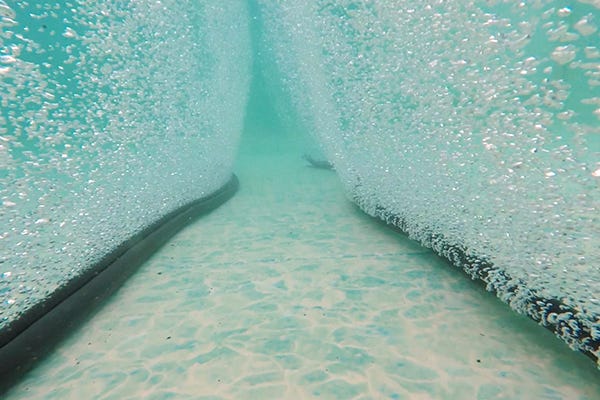
The way these bubble curtains would theoretically work is by having a long tube with multiple holes poked into it. This tube would then be lowered deep into the ocean before air would be pumped throughout the tube to create bubbles. When large arrays of these tubes are assembled, it creates a patch of ocean with continous bubbles blowing up from the bottom.
The logic behind this technology is based in the first stages of an hurricane forming. Hurricanes form when the ocean surface surpasses around 80 degrees Farenheit. These bubble curtains are supposed to blow ubbles of cold water from deep in the ocean up to the relatively warmer top therefore cooling it down. This would stop convection from occuring and present the hurricane.
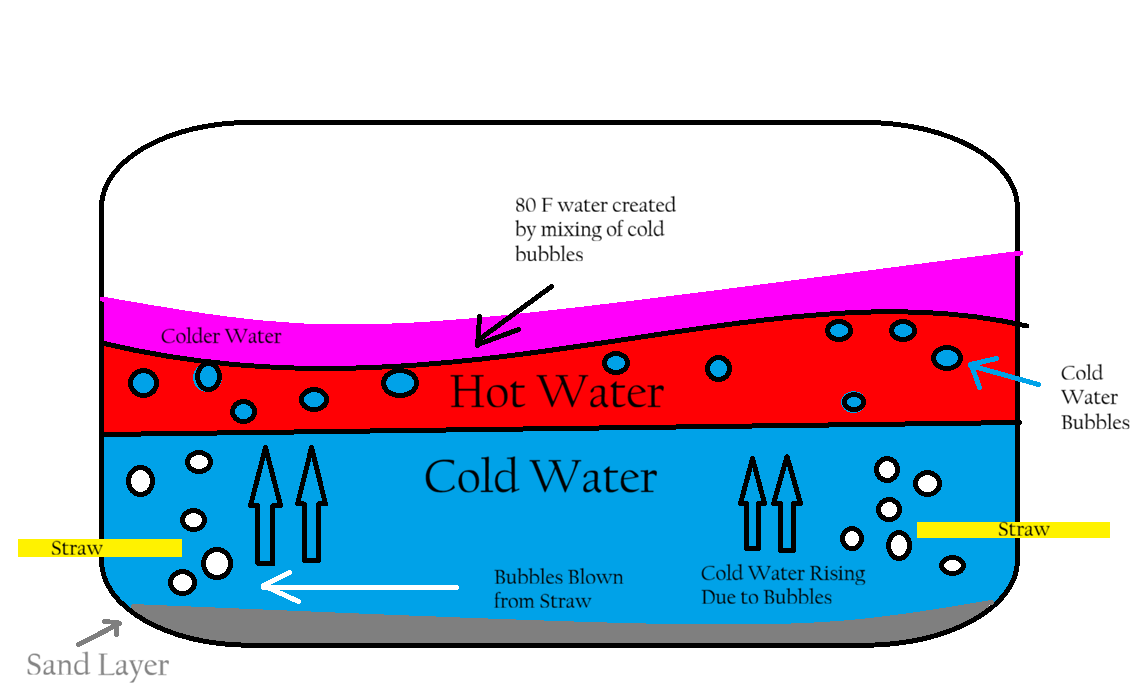
To test this strategy, I ran a small scale test in a simulated ocean. To keep results accurate, I made the test setup as follows. In a plastic container, I added black sand to simulate the ocean bed, and then had a layer of cold water under a layer of warmer water that was added in at around 100F. This water was meant to simulate the type of ocean surface conditions that trigger hurricanes.
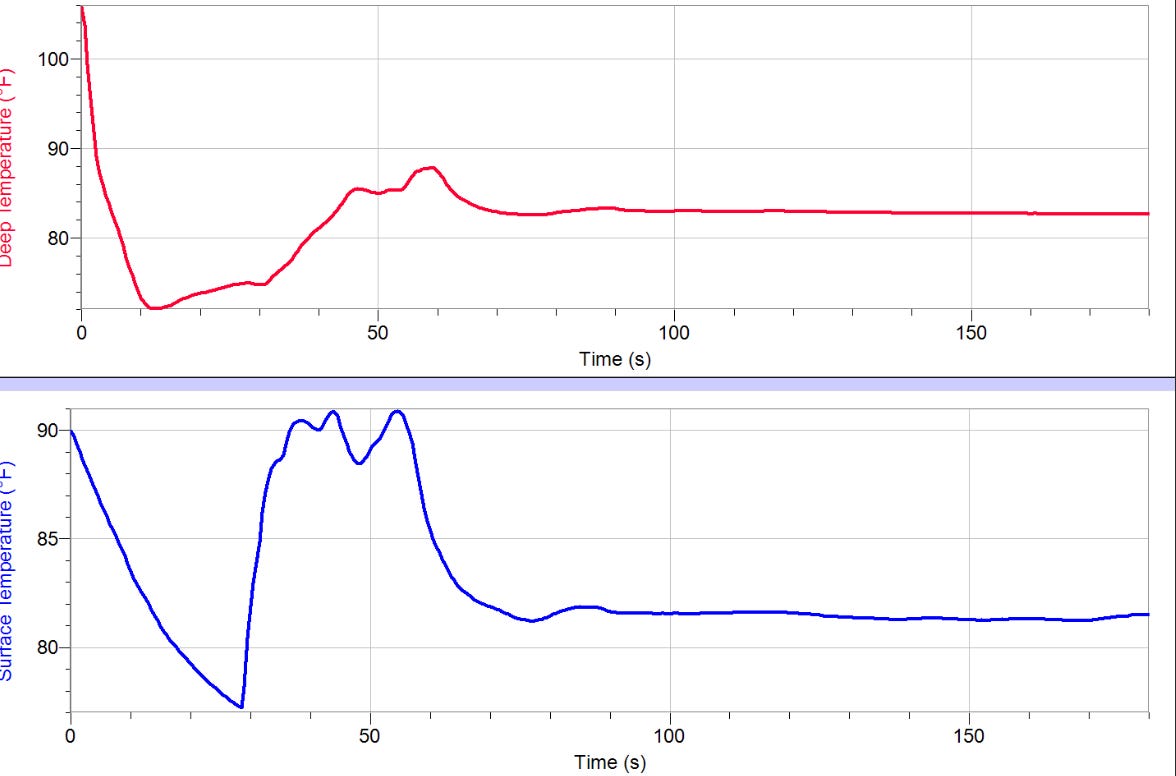
After this, I mounted two temperature probes to the sside of the enclosure. One of these probes I submerged to a depth of 0.5 cm, which allowed it to emasure a localized surface temperature. The second probe was mounted at approximately 9 cm, which allowed me to accurately measure the deep conditions. After this, I had two volunteers blow bubbles through two straws for a 3 minute testing period to simulate the bubble curtains effects. Here are the results from the testing ina graph showing the temperature fluctuation.
Here is the data that I gathered from the test.
Deep Probe:
Test Start:
0.0 - Hot water added; temp 105.7 F
11.5 - Rapid Cooling from water disruption; temp 72.8 F
31.0 - Gradual heating; temp 74.8 F
45.5 - Heating; temp 85.5
54.0 - Stability; temp 85.5
59.0 - Peak; temp 87.8
75.0 - 82.6
Until end - Stable Flatline; temp 82.7
Test End:
Surface Probe:
Test Start:
0.0 - Hot water added; temp 90 F
28.5 - Rapid cooling; temp 77.3
35.5 - Rapid Heating; temp 88.7
38.0 - First Peak; temp 90.4
44.0 - Second Peak; temp 90.8
48.5 - Temperature Dip; temp 88.5
54.5 - Third Peak; temp 90.9
77.5 - Cooling; temp 81.2
86.0 - Small Bump; temp 81.9
Until End- Stable Flatline; temp 81.5
Testing Parameters:
- Surface Temperature probe was taped so tip contacted water surface for consistency and accuracy
- Deep Temperature probe was taped so tip was submerged near the bottom of the water for consistency and accuracy
- Sand layer added to help simulate ocean floor
- Test conducted in large container to keep components proportional (e.g. amount of hot water)
- Hot water dyed red, Cold water dyed blue
Testing Conclusion:
The deep temperature started out the hottest since when the hot water was poured in, the force of the falling water sank it down so it affected the deep probe, causing its initial temperature to be 105 degrees F. However, once the surface settled down, the hot water rose and then the water cooled. After this, the hot water seeped in to the deeper areas of the water, which caused the temperature to gradually increase. However, the bubbles cooled it down and kept the temperature maintained.
The surface temperature started hot, but when the water sank to the deeper parts and the cold water rose up the temperature suddenly dropped. After everything settles, the temperature rose sharply and then spiked a few times. Then, the bubbles significantly cooled it down 10 degrees. Then the temperature remained stable for the remaining half of the test.
Real World Application:
In this test, we will ignore the initial rapid cooling, and only apply the data from when the temperature went up to simulate a hot ocean surface. The water ranged from 90-88 degrees F, which could have resulted in a category 4 hurricane. However, the bubble curtains cooled the water down fast enough to make a difference. The temperature dropped to 80-81 degrees. The test shows for both the deep and surface temperature, the temperature remained stable after bubble cooling proving that temperatures will not rise again and that the solution is effective. A 80 degree ocean temperature is only barely enough to even start a category 1 hurricane, proving that this solution is effective enough to prevent or at least reduce the severity of a hurricane.
After all this, I realized a few things including deciding whether or not I think we should use this technology. I believe that the government should not attempt to control or significantly alter hurricanes, as it could have unpredictable consequences on the storm, it could be used as a token of power by wealthy countries, and it could negatively affect the climate. These issues currently outweigh the positive benefits of preventing hurricanes and it is therefore not worth it to prevent hurricanes.
First of all, one of the major problems with preventing hurricanes as of right now is that it could have unpredictable consequences on the hurricane. For example, in 1947, 180 pounds of dry ice altered a hurricane causing its route to change leading it to make landfall near Savannah, Georgia causing damages. This is one example of how failed attempts to alter or prevent hurricanes could eventually even cause unintended or worse damage. Although other strategies may affect hurricanes in different ways, accidentally changing the hurricane’s path or severity negatively could lead to worse damage from hurricanes than if left naturally.
Furthermore, the power to redirect or stop a hurricane could be used by wealthy countries as a token of power and might not be accessible to all countries that need it. One source says that humans have tried to change weather as a weapon in war today. A technology powerful enough to stop hurricanes could possibly be used as a token of power by powerful countries such as the U.S. and Russia. These technologies might me held exclusively by the government, therefore making the power to stop hurricanes inaccessible to some countries like Mexico. In addition, these new strategies to prevent hurricanes could also be used to worsen or redirect them. This could allow hurricanes to be targeted towards certain areas and used maliciously. Nuclear energy, in the past, was considered a good invention but is now used for making destructive bombs. Due to the nature of the technologies suggested to prevent hurricanes, the same thing could occur.
Additionally, another unintended consequence of preventing or altering hurricanes could be a negative effect on the climate. Some sources point out the negative consequences of preventing hurricanes, including the equator being much warmer and the poles being warmer, alongside reduced rainfall to areas that need it. Although hurricanes are destructive and harmful to humans, they also have an important part in our climate, and altering, preventing, or stopping hurricanes altogether could therefore, preventing hurricanes could lead to future issues with the climate that are more harmful than the hurricane.
Last, our experiment on a hurricane preventing technology showed that preventing hurricanes might be hard to scale or expensive. Our experiment consisted of a large ocean with warm water on the surface and cold water deeper down. The solution to prevent hurricanes that we explored was the bubble curtain technology. To simulate this, we had two people blow into a straw that released bubbles in the deep section of the water to see if the cold bubbles would cool the surface down. Based on the results of our experiment, the surface temperature cooled down to about 80 degrees Fahrenheit. Although this is enough to reduce the severity of the hurricane, the issue could be the scaling, price, or resources. To cool down a tub full of water, we needed two straws constantly blowing bubbles, which could be hard to implement in a large enough area to prevent hurricanes. The bubbles were also quite large, and the force and rate of the bubbles might be hard to maintain over time and distance and would require constant pumping. Therefore, our experiment proves that preventing hurricanes could be difficult and hard to scale, at least with our current technology and solutions.
All in all, due to these issues the concept of preventing, stopping, or altering hurricanes seems to be infeasible and impractical, as it could have unforeseen consequences on the climate, unpredictable failed attempts, unfair power distribution, and also concerns on scaling it up to a operational scale.
This is what I found out from the entirety of the bubble curtain test. Feel free to interpret what you want fromt he data and hae your own opinions. This is just something that I thought was cool :)
Cleaning up after finishing the expirement was pretty fun... At least I got some cool information. Hopefully you found this interesting.