
Clickbait Videos
Not all are equal

In our current day and age, information is so common and widespread that people are trying a variety of methods to get others to view theirs. One of the most prominent examples of this is with videos, specifically clickbait titles and thumbnails. Recently, these thumbnails and titles have been appearing all over platforms such as YouTube. In this article, I would like to explore what I believe are the two main types of clickbait videos and explain their differences.
However, before I begin, I would like to say that I am not heavily opinionated on this matter, and I am not saying that any of the YouTube channels mentioned in this article are scams or wrong. These are simply the categories that I have noticed, and I am not trying to convince you to adopt my opinion.
Type 1:
Viewfarming
The first category of clickbait I noticed was a style I call “viewfarming.” Common trends I have noticed in such videos include heavily exaggerated images, large numbers or statistics, and concepts that seem especially interesting. These types of thumbnails and titles seem to be growing in popularity, and I have seen many YouTube channels adopt this strategy. From my experience, the first major YouTuber that I noticed using this style was MrBeast. Below, you can see an example of what I like to call “viewfarming” thumbnails and titles.

There are some key elements that I would like to highlight in this image. The first is the exaggerated intensity. After watching the actual video, you can see that nothing such as what is depicted in the thumbnail actually occurs. Furthermore, if you look at the facial expressions present in the thumbnail, you can see that they are very intense and exaggerated. This causes the video to be very attention-grabbing, and even if you have no interest in videos like this, it is sure to catch your attention. The next image, however, has some other key elements I want to point out.

There are two elements of attention-grabbing details present in this thumbnail and title. The first, and one of the most important, is present both in the title and the thumbnail. As you can see above, the title says “I Saved 1,000 Animals From Dying.” Specifically, the number 1,000 is a huge element of these clickbait videos. Often, YouTubers will try to use large, rounded statistics to grab attention and show importance.
Another element present in this title is the attention-grabbing exaggeration, similar to the last example. However, in this thumbnail it is more prominent and easier to notice. As you can see, the image has an almost AI-generated feel, with overly dramatic visuals. I believe that visuals and statistics such as these are often targeted at younger audiences who may be less adept at seeing through these emphasized thumbnails.
Type 2:
“Real” Clickbait
Finally, the second style of clickbait thumbnails I noticed could be called “real” clickbait. These thumbnails have some similarities to the previous type, but there are key differences that make them less misleading. The main differences that I have noticed are the delivery of claims and the reduced use of attention-grabbing emphasis. I have noticed this style of “real” clickbait in videos by the YouTuber NileRed. I will use one of his thumbnails and titles below as a reference.
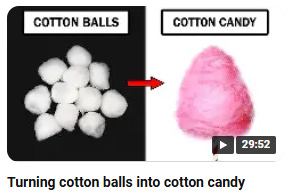
This image is similar to a clickbait thumbnail in the sense that it makes a viewer want to click on it; however, I believe that it accomplishes this in a slightly different way. One key difference is that the thumbnail looks less exaggerated. In the previous thumbnails, many aspects were edited or heavily emphasized. Here, however, the thumbnail is very simple, along with the title.
The reason this technically classifies as clickbait is due to the nature of the concept. It is very attention-grabbing and presents an almost ridiculous proposal to the viewer. However, the difference is that the video itself consists entirely of this topic. One of the videos mentioned before was titled “World’s Strongest Man vs. Robot.”
In that video, the title was still fulfilled, since there was a scene that involved the world’s strongest man versus a robot. Therefore, both of these thumbnails technically fulfill their claims; however, I believe they do so for different reasons.
As an analogy, we could think of the two thumbnails as introductions to a speech. The first thumbnail, “World’s Strongest Man vs. Robot,” serves as a hook. While it is mentioned in the video, its purpose is mainly to make the viewer click on the video and continue watching.
However, the second thumbnail acts more like a summary, describing what the video will actually be about. If you watch the video “Turning Cotton Balls into Cotton Candy” by the YouTuber NileRed, you will see that the entire video focuses on this topic. Therefore, the thumbnail acts less like a hook and more like a summary that allows the viewer to decide if they want to watch it.
All in all, both of these methods of gaining views work, and neither one is explicitly better. It can sometimes be difficult to differentiate between these two types of thumbnails, and as new trends develop, I expect these methods to change significantly. However, these are simply my observations of what is happening, and it is entirely possible that I may be wrong. Thank you for taking the time to view my perspective on clickbait titles and thumbnails.